The Q1 2026 Operations & Fulfilment Roadmap
This guide is your 90-day sprint plan to take you out of reactive fire-fighting mode and into proactive strategic planning.
The Q4 dust has settled. Whether you hit your revenue targets or missed them, the operational cost of getting there is now visible.
Most brands treat Q1 as a recovery period. They lick their wounds and wait for spring. But for high-growth operations leaders, Q1 is the most critical strategic window of the year.
It is the only time in the calendar where volume is low enough to safely overhaul broken infrastructure without risking revenue. This guide is your 90-day sprint plan to take you out of reactive fire-fighting mode and into proactive strategic planning.
The golden window
Operational risk is directly correlated to order volume
In January and February, order volumes are typically at their lowest. This creates a “Golden Window” to execute strategic projects like migrating 3PLs, integrating a new ERP, or overhauling inventory logic, with minimal disruption.
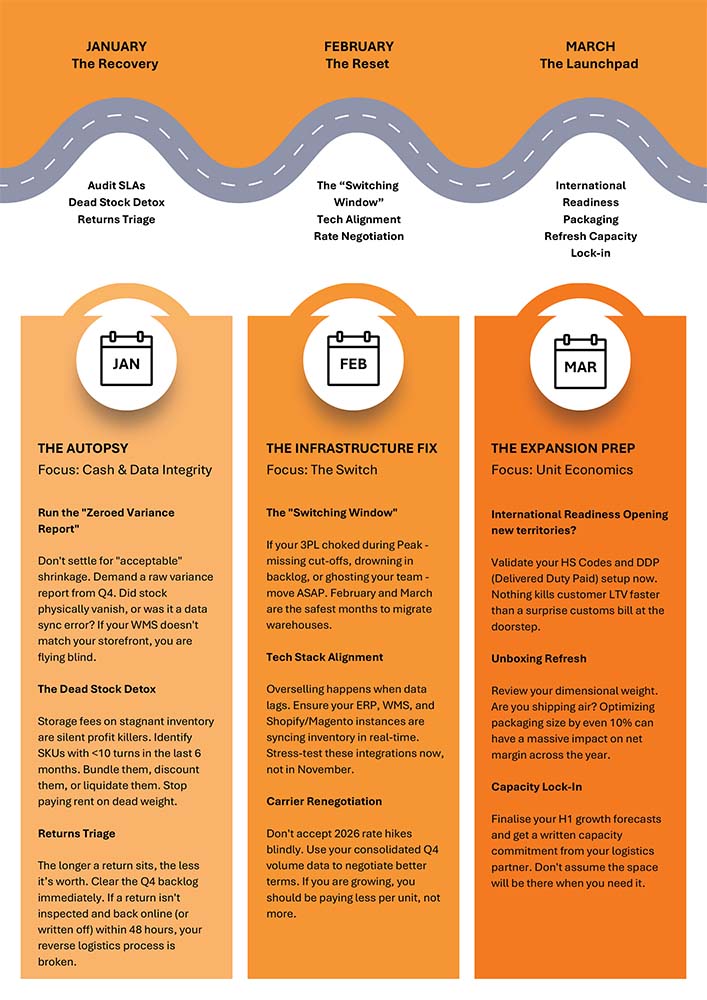
January: The recovery (The autopsy – cash and data integrity)
Run the “zeroed variance report”
Don’t settle for “acceptable” shrinkage. Demand a raw variance report from Q4. Did stock physically vanish, or was it a data sync error? If your WMS doesn’t match your storefront, you are flying blind.
The dead stock detox
Storage fees on stagnant inventory are silent profit killers. Identify SKUs with <10 turns in the last 6 months. Bundle them, discount them, or liquidate them. Stop paying rent on dead weight.
Returns triage
The longer a return sits, the less it’s worth. Clear the Q4 backlog immediately. If a return isn’t inspected and back online (or written off) within 48 hours, your reverse logistics process is broken.
February: The rest (The infrastructure fix – the switch)
The “switching window”
If your 3PL choked during Peak – missing cut-offs, drowning in backlog, or ghosting your team – move ASAP. February and March are the safest months to migrate warehouses.
Tech stack alignment
Overselling happens when data lags. Ensure your ERP, WMS, and Shopify/ Magento instances are syncing inventory in real-time. Stress-test these integrations now, not in November.
Carrier renegotiation
Don’t accept 2026 rate hikes blindly. Use your consolidated Q4 volume data to negotiate better terms. If you are growing, you should be paying less per unit, not more.
March: The launchpad (The expansion prep – unit economics)
International readiness opening new territories?
Validate your HS Codes and DDP (Delivered Duty Paid) setup now. Nothing kills customer LTV faster than a surprise customs bill at the doorstep.
Unboxing refresh
Review your dimensional weight. Are you shipping air? Optimising packaging size by even 10% can have a massive impact on net margin across the year.
Capacity lock-in
Finalise your H1 growth forecasts and get a written capacity commitment from your logistics partner. Don’t assume the space will be there when you need it.
Operations and fulfilment is a growth engine – we’d love to help build yours!
Many e-commerce brands treat operations as a cost centre – something to be minimised. Brands that win, treat operations as a competitive advantage – an engine to be optimised.
Book a Q1 strategy call today to discuss your current set-up and biggest challenges.